
Hello, little dreamers! 🫶
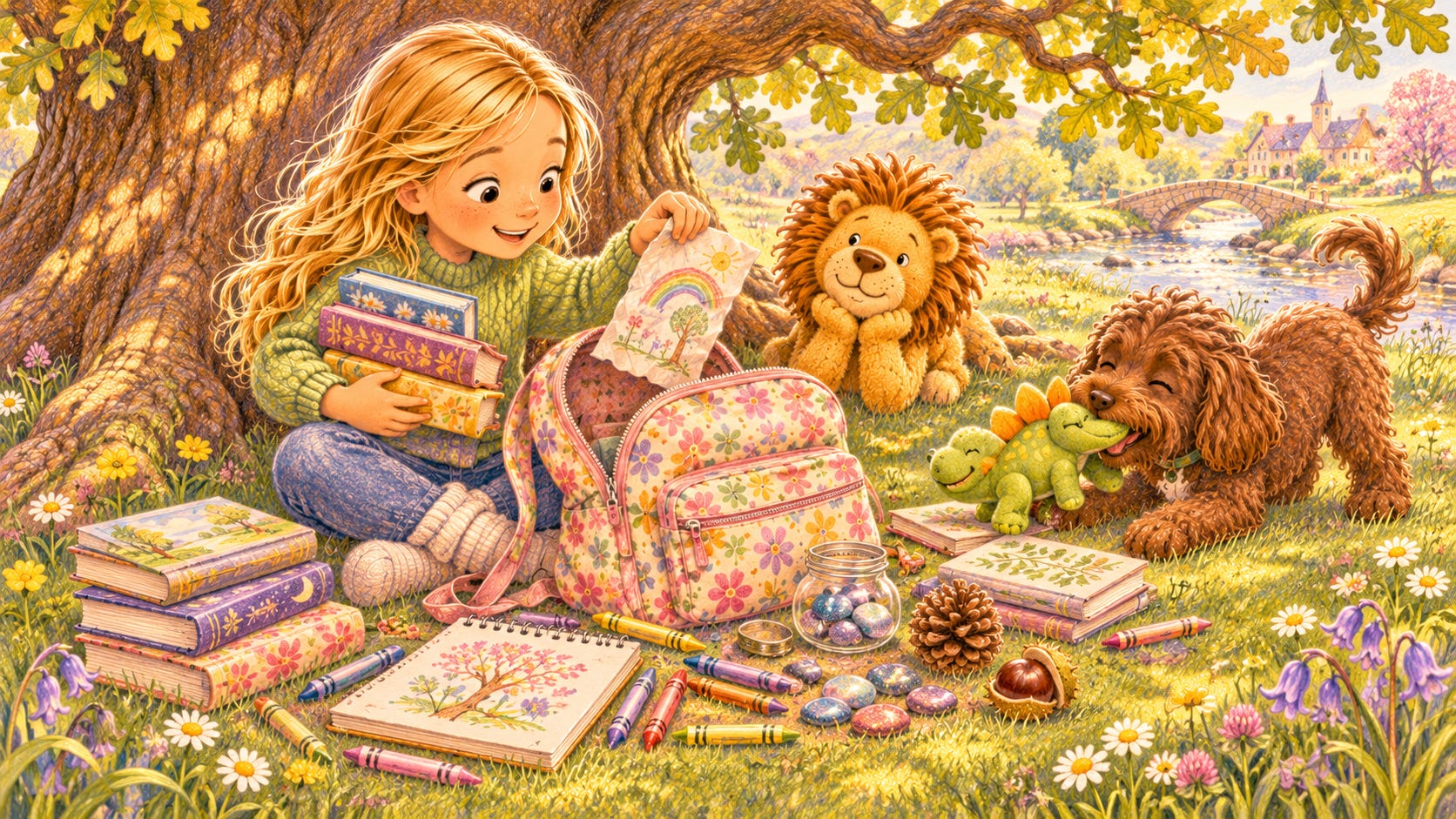
This week, Scarlett discovered something rather interesting.
Her backpack had become so heavy that it was making her adventure difficult.
And when she finally stopped to look inside, she discovered she’d been carrying all sorts of things she didn’t really need.
Books.
Pebbles.
Crayons.
And a dinosaur that Pudding was extremely pleased to find.
But that wasn’t the only thing Scarlett discovered.
She realised that sometimes our thoughts and feelings can become heavy too.
And just like her backpack, it can help to stop, take a look inside and work out what we need.
So today, we’re going to make something special.
Your very own Feelings Backpack!
Don’t worry.
You won’t need an actual backpack.
Although if Pudding were here, he’d probably insist on bringing one.
Preferably filled with biscuits.
🌱 Activity 1: Draw Your Feelings Backpack
What you’ll need
A piece of paper
Coloured pencils, crayons or felt-tip pens
A little imagination
A quiet moment to think
Step 1: Draw your backpack
In the middle of your paper, draw a big backpack.
Make it as colourful, sparkly or wonderfully unusual as you like.
Perhaps it has rainbow straps.
Perhaps it’s covered in stars.
Or perhaps it looks like Pudding.
Although a backpack shaped like Pudding might spend far too much time chasing squirrels.
Step 2: Think about what’s inside
Imagine your backpack is carrying some of the things you’ve been thinking and feeling this week.
Inside it, you might draw or write:
💛 Something that made you happy.
💙 Something you’ve been worrying about.
💚 Something you’re proud of.
💜 Something that made you feel sad or disappointed.
🧡 Something you’re looking forward to.
You don’t have to include all of these.
And you don’t have to show anyone your drawing unless you want to.
This is your backpack.
Step 3: Notice what feels heavy
Look at the things you’ve drawn.
Is there anything that feels a little difficult to carry?
Perhaps it’s a friendship worry.
Something that happened at school.
Or a mistake you keep thinking about.
Choose one thing, if you’d like to.
And ask yourself:
“Does this need something from me?”
Perhaps you need to talk to someone.
Perhaps you need help finding a solution.
Or perhaps you need to remind yourself of something kind and true.
Step 4: Find a helping hand
Next to your backpack, draw a hand.
Inside the hand, write or draw someone you trust.
It might be Mummy, Daddy, Granny, a teacher, a carer or another grown-up who helps you feel safe.
This is your reminder that you don’t have to work everything out alone.
And if the first person you ask can’t help, it’s okay to ask another trusted grown-up.
Step 5: Choose what you want to carry forward
Finally, draw a little heart beside your backpack.
Inside it, write three things you’d like to carry with you into the new week.
Perhaps:
“I am learning.”
“I can ask for help.”
“I am loved exactly as I am.”
Or make up your own.
Because not everything we carry is heavy.
Some things make our hearts feel wonderfully full.
🐾 Pudding’s Five-Minute Backpack Check
Pudding has a very important job for you this week.
At the end of each day, take five little minutes to ask yourself:
1. What made my tail wag today?
Something that made you smile, laugh or feel happy.
2. What made my paws feel heavy?
Something difficult, upsetting or worrying.
3. Is there anything I’d like help carrying?
A feeling, question or problem you could share with someone you trust.
You can talk about your answers, draw them or simply think about them.
There are no right or wrong answers.
And there is definitely no need to get everything perfect.
Pudding has checked.
Twice.
🦁 Lenny’s Little Reminder
“Your worries are worth listening to, my little dreamer.
“And so are you.
“You don’t have to make every difficult feeling disappear.
“Sometimes, the kindest thing you can do is notice how you feel and let someone help you find your next step.”
✨ A Moment to Wonder
Before you finish, take one last look at your backpack.
Imagine it resting beside you.
You don’t have to pick it up straight away.
You can take your time.
You can ask for help.
And you can choose what you need for the next part of your journey.
Now ask yourself:
“If I could make one thing feel a little lighter this week, what would it be?”
There doesn’t have to be a perfect answer.
Just a little curiosity.
And perhaps the beginning of a new way of looking at things.
Dream big dreams, believe in yourself, and remember that asking for help is one of the bravest things you can do.
With love from Scarlett, Pudding and Lenny. 🫶🐾🦁
💛 Dream Big Circle Extra
An extended Sunday Toolkit for paid subscribers
The Backpack Sorting Station
An extra activity for children and their trusted grown-ups
Sometimes, knowing that we have a worry is only the beginning.
The next question is:
“What can I do with it?”
And that’s what this activity is all about.
🌈 What you’ll need
Your Feelings Backpack drawing from the first activity, plus three pieces of paper or three different coloured pencils.
Create three spaces with these headings:
1. I Can Do Something
These are worries where there might be a small action you can take.
For example:
“I’m worried because I haven’t finished my homework.”
Perhaps you could make a plan, ask for help or set aside some time to finish it.
2. I Need Some Help
These are worries that feel too difficult to manage alone.
For example:
“Something happened at school, and I don’t know what to do.”
Perhaps you could speak to a parent, carer, teacher or another trusted adult.
Remember, you can ask for help even when you aren’t sure exactly what the problem is.
3. I Can’t Know or Control Everything
These are worries about things you can’t completely control or don’t have enough information to understand yet.
For example:
“My friend didn’t smile at me today. Maybe they don’t like me anymore.”
You know your friend didn’t smile.
You don’t know why.
Perhaps they were tired.
Perhaps they were thinking about something else.
Perhaps they were having a difficult day.
Instead of deciding what someone else must be thinking, you could ask a kind question, stay curious and remember that there may be more than one explanation.
🌱 Now sort your worries
Choose a few of the worries from your Feelings Backpack.
Think about which space each one belongs in.
You can write them, draw them or talk them through with your grown-up.
And here’s something important.
A worry might belong in more than one space.
For example, you might not be able to control someone else’s behaviour, and you can still ask a trusted grown-up for help with how it’s affecting you.
There isn’t always one neat answer.
The point is to get curious, not to get everything right.
💬 The Five-Minute Backpack Conversation
An exclusive companion script for grown-ups
This conversation can be used at bedtime, after school or whenever your child seems to be carrying a little more than usual.
Find somewhere comfortable.
Perhaps sit together on the sofa, snuggle under a blanket or take a quiet walk.
Let your child know this is an invitation, not something they have to complete.
Begin gently:
“I’ve been thinking about Scarlett and her backpack.
“She didn’t realise how much she was carrying until she stopped and looked inside.
“I wonder whether we could look inside our imaginary backpacks together?”
Give the grown-up’s backpack a turn first.
You might say:
“Today I felt happy when we had our cuddle this morning.
“I felt a little worried about something I needed to finish at work.
“And I felt grateful when someone helped me with something.”
Choose a small, age-appropriate example. The aim is to model talking about feelings, not to ask your child to carry your worries.
Then invite your child:
“Would you like to tell me about one thing in your backpack today?”
If they answer, listen.
Try not to rush into fixing things.
You might say:
“That sounds like it was difficult.”
“I can understand why you felt that way.”
“Thank you for trusting me enough to tell me.”
Then ask one important question:
“Would you like me to listen, give you a cuddle, or help you think about what we could do?”
You may be surprised by the answer.
Sometimes children want a solution.
Sometimes they want reassurance.
And sometimes they simply need someone to sit beside them while they find their own words.
If they want help working something out:
“Let’s think about what we know for sure.
“What might we be guessing?
“And what’s one small thing we could do next?”
This helps children begin to separate facts from assumptions, without dismissing what they’re feeling.
Close with reassurance:
“Whatever’s in your backpack, you can always talk to me.
“You don’t have to have all the answers.
“And you don’t have to work everything out by yourself.”
A cuddle is optional.
Although highly recommended by Pudding.
🌟 The Weekly Backpack Ritual
An extra practice to help make emotional awareness part of everyday family life
One of the loveliest things we can offer children is a space where talking about feelings becomes normal.
Not something we only do when something has gone wrong.
Something we do because our thoughts and feelings matter.
So here’s a simple little ritual you could introduce each Sunday.
Our Family Backpack Check-In
Sit together for a few minutes.
Each person who wants to join in can share:
One thing I’m keeping: A lovely memory, something I’m proud of or something I’m grateful for.
One thing I’m working through: A worry, disappointment or challenge I haven’t quite figured out yet.
One thing I’d like help with: Something that would feel easier with support.
Nobody has to share more than they’re comfortable with.
And nobody needs to come up with an instant solution.
You might even draw a little backpack together and add different things each week.
Over time, your child will begin to see something very important.
Feelings change.
Worries can be talked about.
Challenges can be worked through.
And asking for help is a perfectly ordinary part of being human.
💛 A Note for Parents and Carers
There’s something beautifully simple about this week’s activities.
They’re not asking children to stop feeling worried.
They’re helping children learn to notice their worries, become curious about them and recognise when support might be useful.
That’s an important distinction.
Because the goal isn’t to raise children who never feel anxious, disappointed or uncertain.
It’s to help them understand that those feelings are part of life, and they can learn ways to navigate them.
As grown-ups, we don’t need to have all the answers either.
Sometimes our greatest gift is our presence.
Our willingness to listen.
And our ability to say:
“I don’t know yet, sweetheart. Let’s find out together.”
If a worry is persistent, significantly affects daily life or involves a child’s safety, seek appropriate professional or safeguarding support rather than relying on an activity alone.
🫶 One Last Moment to Wonder – For the Grown-Ups
As you help your child explore their backpack, perhaps take a moment to consider your own.
What have you been carrying because you believe you should?
What have you been holding onto because you don’t want to burden someone else?
And what might change if you gave yourself the same kindness, patience and permission to ask for help that you’re offering your child?
Our children don’t need us to be perfect.
They need us to be present.
Curious.
Kind.
And willing to keep learning alongside them.
Because when we show children that asking for help is an act of courage, we’re giving them something they can carry for the rest of their lives.
With love from our family to yours.
Kim-Adele, Scarlett, Pudding and Lenny 🫶🐾🦁
🌱 A grounding moment — try this together
Place one hand on your heart. Take one slow breath. Think of one person who helps you feel safe.
That’s enough. That’s really enough. 🫶
