
Hello, kind grown-up,
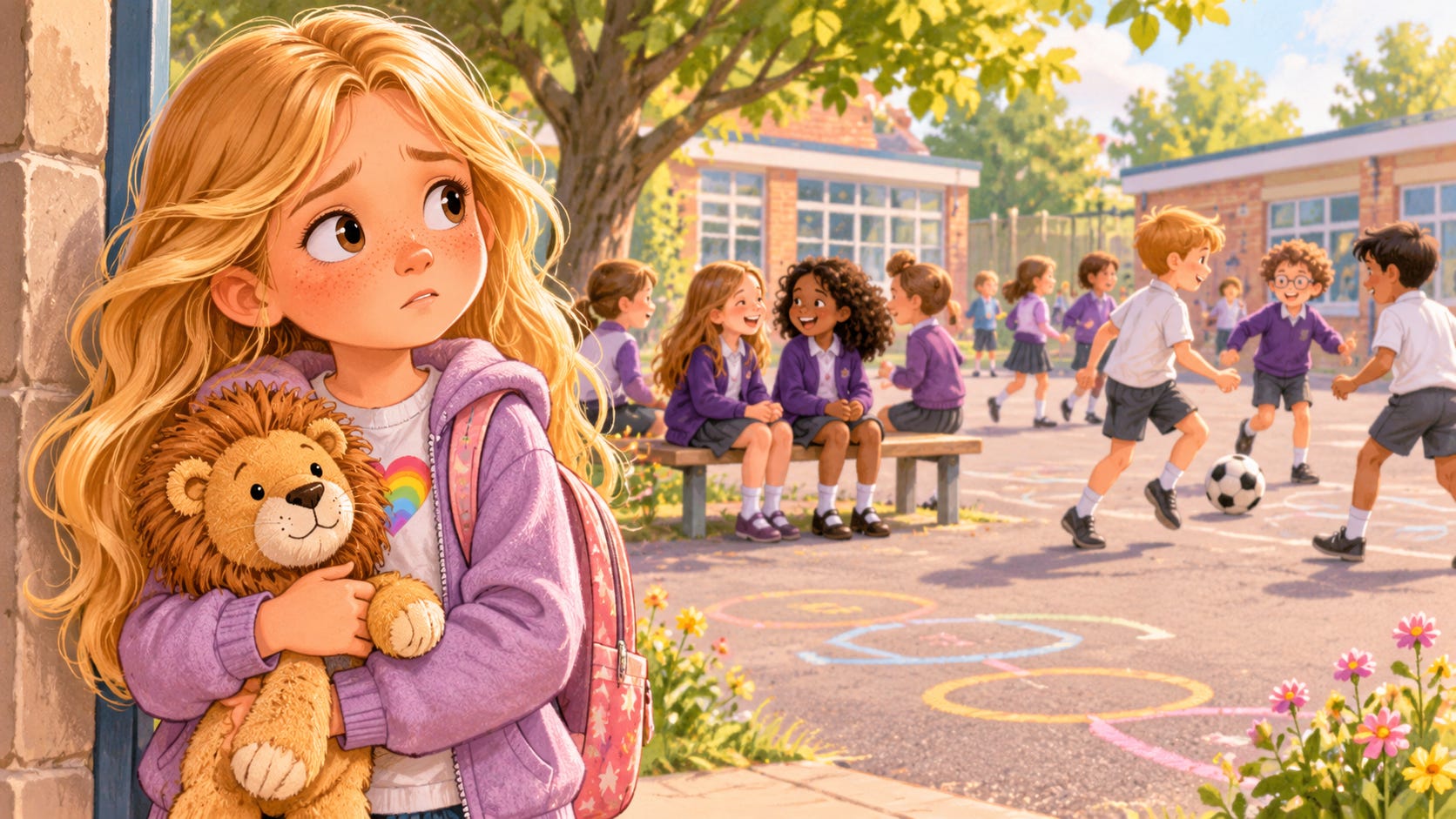
I wonder if you’ve ever watched a child standing at the edge of a playground.
The other children are laughing.
Games are happening.
Friendships are unfolding.
And there, just a little distance away, stands a child who isn’t quite sure where to go.
Perhaps they’re looking towards a group of friends.
Perhaps they’re pretending to be interested in something else.
Perhaps they’re waiting for somebody to notice them.
Or perhaps they’re simply standing very still, wondering whether there’s room for them.
It’s such a small moment from the outside.
And sometimes, inside that little person, it can feel enormous.
Because feeling left out isn’t always about missing a game.
Sometimes it’s about a much bigger question.
“Do I matter to these people?”
And that, dear Grown-Up, is a question we need to handle with care.
💛 The Feeling Is Real, Even When the Story Might Not Be
This week, Scarlett found herself standing alone at playtime.
Maisie and Anya were laughing together.
Sam and Daniel were organising a game.
Everyone seemed to know where they belonged.
Except Scarlett.
And somewhere inside her, a thought appeared.
They don’t want me.
Now, Scarlett hadn’t actually asked to join them.
Nobody had told her to go away.
Nobody had said she wasn’t welcome.
She’d noticed her friends were busy, and her mind had tried to explain what that meant.
That’s something our minds do remarkably well.
They notice little pieces of information and begin filling in the spaces between them.
Sometimes accurately.
Sometimes not.
And when children are feeling unsure of themselves, those explanations can become rather unkind.
They don’t like me.
Everyone has friends except me.
There’s something wrong with me.
The feeling of being left out may be completely real.
And the conclusion the child has reached about why it’s happening may still need exploring.
We can validate a feeling without automatically agreeing with the story attached to it.
Instead of saying:
“Don’t be silly, of course they like you.”
We might try:
“That sounds really lonely.”
And then:
“Can you tell me what happened?”
We don’t need to rush towards reassurance.
First, we need to understand.
🌱 Belonging Is a Human Need, Not a Reward
There’s something I would love every child to grow up knowing.
Belonging isn’t something we earn by being impressive enough.
Children shouldn’t have to be the funniest person in the group.
The fastest runner.
The most confident speaker.
The child who always agrees.
Or the one who never makes a mistake.
They deserve kindness and respect simply because they’re human.
And yet, when children feel excluded, they sometimes begin searching for something they can change about themselves.
Perhaps if I were funnier.
Perhaps if I dressed differently.
Perhaps if I liked what everyone else likes.
Perhaps if I stopped being so quiet.
Perhaps if I wasn’t quite so much myself.
Those thoughts can be painful.
Because somewhere along the way, a child may begin believing that acceptance depends on becoming someone different.
And this is where our response matters.
We can help them understand that healthy friendships involve mutual kindness, respect, shared enjoyment and making room for one another.
Not endless self-adjustment.
Of course, children learn to compromise.
They learn to take turns.
They discover that different situations call for different behaviours.
That’s part of growing.
And there’s an important difference between adapting how we participate and hiding who we are because we’re frightened of rejection.
Children can learn to be flexible without believing they must become someone else to be worthy of friendship.
🦁 When Our Instinct Is to Fix It
When a child tells us they feel left out, our hearts often respond before our minds have had a chance to understand.
We want to make the hurt disappear.
So we offer solutions.
“Why didn’t you just join in?”
“Go and find someone else.”
“Don’t worry about them.”
“You’ve got plenty of other friends.”
Sometimes those suggestions are useful.
And sometimes they arrive before the child has felt heard.
Imagine Scarlett telling us that she stood alone at playtime.
And our first response being:
“Well, why didn’t you go and talk to them?”
What might she hear?
Perhaps:
I should have known what to do.
I’m making a fuss.
It’s my fault I felt lonely.
That may not be what we intended.
And yet children often hear our words through the feelings they’re already carrying.
What if we began somewhere gentler?
“That must have felt uncomfortable.”
“What were you thinking when you saw everyone playing?”
“Did anyone say you couldn’t join, or were you unsure whether you could?”
Those questions create space for understanding.
And understanding gives us a much better starting point for deciding what to do next.
🌻 Feelings, Facts and the Stories We Tell Ourselves
You may remember that Scarlett has been learning to separate what she knows from what she imagines.
This is particularly useful when friendships feel uncertain.
Consider the difference between these statements.
“Maisie and Anya were talking together.”
That’s an observation.
“They didn’t ask me to join them.”
That may also be a fact.
“They don’t want to be my friends anymore.”
That’s an interpretation.
It might be true.
It might not.
And we don’t yet have enough information to know.
Helping children recognise this distinction isn’t about teaching them to doubt their experiences.
It’s about helping them become curious before accepting the most painful explanation.
We might gently ask:
“What do we know happened?”
“What are we guessing?”
“Could there be another explanation?”
“What might help us find out?”
And sometimes the answer is as simple as asking:
“Can I join you?”
Other times, children may need more support.
And that’s okay.
❤️ Sometimes Children Really Are Being Left Out
There’s another side to this conversation, dear Grown-Up.
And it’s one we mustn’t overlook.
Sometimes children aren’t imagining exclusion.
They are experiencing it.
Perhaps a group repeatedly tells them they’re not welcome.
Perhaps friendships are being used to control or punish.
Perhaps invitations are deliberately withheld.
Perhaps children are being mocked, ignored or made to feel that belonging depends on doing something they’re uncomfortable with.
In those moments, telling a child to question their thoughts isn’t enough.
And asking them to keep trying to join the same group may make the situation worse.
We need to listen carefully.
Look for patterns.
Understand what’s happening.
And intervene when necessary.
A child doesn’t need to become more resilient at tolerating unkindness.
They need to know that unkindness is something adults will take seriously.
Sometimes that means speaking with a teacher.
Sometimes it means helping a child find safer friendships.
Sometimes it means addressing bullying or repeated exclusion through the appropriate school processes.
And sometimes it means recognising that a particular friendship isn’t healthy.
Belonging should never require a child to sacrifice their safety, dignity or sense of self.
🌈 The Courage to Reach Towards Connection
There’s something else I love about Scarlett’s experience this week.
After sitting quietly beneath the tree, she began questioning the story her mind was telling.
She realised she didn’t actually know that her friends didn’t want her there.
And when Anya called her name, Scarlett was able to take a small step towards them.
She hadn’t transformed into somebody more confident.
She hadn’t suddenly become the loudest person in the playground.
She was still Scarlett.
A little uncertain.
A little hopeful.
And willing to try.
That’s an important lesson.
We don’t need children to become fearless before they can connect.
We can help them practise small, manageable ways of reaching towards others.
“Can I join in?”
“What are you playing?”
“Would you like to come and sit with me?”
“Shall we make up a game?”
And we can also teach them that an invitation may not always be accepted.
Sometimes a game is already full.
Sometimes people want to do something different.
Sometimes a friendship changes.
That can be disappointing without meaning there’s something wrong with the child.
The aim isn’t to guarantee acceptance everywhere.
It’s to help children recognise where connection is mutual, respectful and welcoming.
🐾 A Little Lesson from Pudding
Now, you know our beloved Pudding.
Our chocolate-brown, curly-haired bundle of enthusiasm.
When Scarlett comes home, he doesn’t spend several minutes wondering whether he’s interesting enough to deserve her attention.
He simply arrives.
Usually at considerable speed.
With a wagging tail, an enormous heart and occasionally a toy that nobody asked him to bring.
And if Scarlett happens to be busy?
Well, he may make a rather dramatic noise.
Or place his head on her knee.
Or sit beside her and wait.
He certainly has his moments of impatience.
And he reminds us of something rather lovely.
Connection doesn’t always require a performance.
Sometimes it’s simply about being present.
Offering friendship.
Showing kindness.
And making room for someone else.
Of course, human friendships are more complicated than puppy cuddles.
And children need to learn about boundaries, consent and respecting other people’s choices.
Yet there’s something worth remembering in Pudding’s wonderful enthusiasm.
We can reach towards connection without first deciding that we need to become more impressive.
🌙 When Being Alone Isn’t the Same as Being Lonely
There’s one final distinction I’d love us to make.
Not every child who spends time alone is feeling excluded.
Some children genuinely enjoy quieter moments.
Some need a little space after a busy morning.
Some prefer one close friend to a large group.
And some are perfectly content to read, draw or simply watch the world around them.
We don’t need to treat every solitary moment as a problem.
Instead, become curious.
“Are you enjoying a little quiet time?”
“Or are you wishing you had someone to play with?”
The answer matters.
Because belonging doesn’t mean being surrounded by people all the time.
It means having opportunities for meaningful connection and feeling accepted in relationships that matter.
And sometimes, feeling comfortable in our own company is part of that too.
💛 A Gentle Reminder for the Grown-Up
Dear Grown-Up,
I know how hard it can be when a child tells you they feel unwanted.
Especially when you’ve watched them offer kindness, friendship and warmth to others.
You may feel angry on their behalf.
You may want to telephone another parent.
You may find yourself remembering moments when you felt excluded as a child.
And perhaps a part of you wants to promise that they’ll never feel that way again.
We can’t make that promise.
Friendships will change.
Groups will shift.
There will be misunderstandings, disappointments and moments of uncertainty.
And we can help children develop the skills to navigate those experiences.
Not by teaching them that rejection doesn’t hurt.
It does.
Not by insisting everyone will always include them.
They won’t.
And not by telling them to become more confident, louder or easier to like.
Instead, we can help them discover something much more dependable.
Their worth doesn’t rise or fall according to whether a particular person or group includes them.
We can teach them to recognise kindness.
To seek reciprocal friendships.
To communicate their needs.
To ask for help.
To respect other people’s boundaries.
And to walk away from relationships where they’re repeatedly treated without care.
All while reminding them that they are already worthy of connection.
🫶 One Final Thought
The next time a child tells you they feel left out, perhaps begin with the simplest thing.
Listen.
Not to correct.
Not to reassure immediately.
Not to decide whether they’re right or wrong.
Simply to understand.
Then, when they’re ready, become curious together.
What happened?
What did they feel?
What do they know?
What might they be imagining?
And what support or next step might help?
Sometimes the answer will be a little courage.
Sometimes it will be a different friendship.
Sometimes it will be a conversation.
Sometimes it will be adult intervention.
And sometimes it will simply be sitting beside them while the uncomfortable feeling settles.
Because children don’t need us to guarantee that everyone will accept them.
They need us to help them understand that their worth is never determined by someone else’s willingness to make room.
And perhaps one of the most powerful things we can say is:
“You never have to become someone else to deserve kindness, friendship and belonging.”
With love and a great big lion-hearted hug,
Lenny 🦁💛
Your faithful friend, gentle question-asker and reminder that belonging begins with kindness, not perfection.
Dream big dreams. 🫶
